Showing posts with label company. Show all posts

Saturday, June 29, 2013

Students use Solar Power for "Sun Grand Prix"

     
         Friday, June 28, 2013, was featured the hottest day of the year, defining that it was also one of the best days to solar race at the Circuit of the Americas track in Texas. The event was known as the "Formula Sun Grand Prix." The cars are made by college students from 11 universities, who are putting their young engineers to the test.
         "If we had another month and another $10,000, it would probably look slick, but we had neither of those things so we use duct tape," Raul Molina with the University of Texas Solar Team said. The students design, build, and raise funds for their teams, just as any other business technique would be used for their own products.
          "There is a reason that the company is having you look at this and it's to make profit for the company and not for you to test out your cool little widget," race organizer Gail Luek said. Joel Thongson with Western Michigan University had to combine his book knowledge with a little elbow grease to get the job done. "This really applies to what most of us are going to do in our jobs so it is really great real world experience," he said.
            The solar cars have the capacity to reach speeds up to 60 miles per hour, but they were only hitting about 35 on Friday. The race continues today (Saturday, June 29, 2013) at the track from 9am to 5pm EST.

Wednesday, June 5, 2013

New Jersey Approves $446 Million Solar Investment

        New Jersey state regulators had approved a proposal brought up by the utility company, Public Service Electric & Gas (PSE&G), which the plan triggered permission granted to go ahead on two projects increasing the involvement and usage of solar power. The two projects will both be financed by an incremental increase in customers' utility bills.
         According to Associated Press reports, the first project consists of offering nearly $200 million in loans to commercial and residential areas to install solar power systems in their buildings. The second project will help finance an extension of the utility's Solar4All program through 2016 that helps to develop solar installations primarily on unused landfills and former industrial sites, known as brownfields.
          However, the state-appointed advocate for utility customers has criticized the landfill decision as creating an unfair market advantage for PSE&G since the company is expected to recover its costs through rate increases. In return, New Jersey had, instead, approved the proposal under the conditions that adjustments be made in PSE&G's utility rates such as reducing greenhouse gas emissions, raising electric bills for residential customers by $11.45 a year and costs to the same gas customers by $2.18 annually.


Monday, April 22, 2013

ABB bets on Solar Energy of $1 Billion

     
     Swiss Industrial group ABB, also known as the world's biggest supplier of industrial motors and power grids, had announced recently on Monday that it had agreed to pay $6.35 per share in cash for Power-One Inc., the second-largest maker of solar inverters which allows solar power to be fed into the power grids. The offer price is claimed to be 57% above Power-One's closing price on Friday, boosted by $266 million in net cash held by debt-free Power-One Inc. However, if the asset value is to be quoted without the cash involved, Power-One's enterprise value would amount to a total of $762 million.
     As solar power is steadily rising to compete with conventional forms of energy such as gas and coal, demand for solar power is also increasing. There is a similar pattern towards solar inverters as well as they are needed to feed that power into large electric grids from commercial panel installations and smaller units found in factories and homes. "We consider the acquisition of Power-One as a smart strategic move for ABB to broaden its solar power portfolio at the right time," Vontobel analysts noted.
     Mainly because of solar power's relatively complex technology, solar inverters are to be one of the last profitable parts of the solar value chain (for makers of solar cells and panels have suffered drastically from the fact that their products are easy to replicate). However, ABB believes that the solar market is set to grow its way out of overcapacity as electricity costs rise and solar power systems make it a more competitive source of energy. "ABB is currently buying into solar energy because it sees a shift in demand towards emerging markets such as China and the Middle East," said Ulrich Spiesshofer, Head of ABB and Motion, a business that includes ABB's solar activities. "Solar is, long-term, the fastest-growing renewable generation market in the world. ABB believes in this market," Spiesshofer claims in a company video.

Tuesday, March 26, 2013

New Solar Gear Introduced

            Inverters are the components within powered devices like solar panels and batteries, which helps convert the power generated into usable power. There has been many research efforts involving solar panel inverters as some people may choose to move from a single large central inverter to smaller "microinverters" embedded on each solar panel. However, Empower Micro Systems, a chip startup that has been running for a year and a half now, has furthered this research and developed a low-voltage solar microinverter based on new chip designs, which has became more reliant, cost-effective, and efficient.

            Empower Micro Systems CCO Jon Bonanno has claimed that the company's inverter technology "is a quantum change in how solar is done." This newly developed chip component can be applied anywhere from a solar panel system to a rack or frame. Bonanno also notes that the inverter is 5x more reliable, 5% more efficient, and costs 20% less than traditionally used inverters. The overall solar system cost can be lowered because of the rising potential of a lower inverter cost, in addition to the dropping prices already of solar panels.
           Empower Micro Systems does not plan on manufacturing the inverter box itself but the company tries to respectfully adopt Intel's code in churning out the chips inside the inverter devices. Bonanno is confident of the power of the inverter technology, which is known as the "Universal Micro Power Inverter." He believes it can "replace all solar inversion options, hands down." The key technologies of the solar inverter includes how the system on a chip synchronizes and controls the power flow at a low-voltage rate as well as the design of the inverter box.
           Bonanno remarks that the company has already signed one agreement with a "top-three" module maker (and is in discussions with many module makers and product vendors) to bring this hardware into the market. This year, it is planned for the inverter to be certified and could be produced in pilot production by the third quarter of 2013.

Tuesday, February 12, 2013

A Hospital Running on Solar Power?

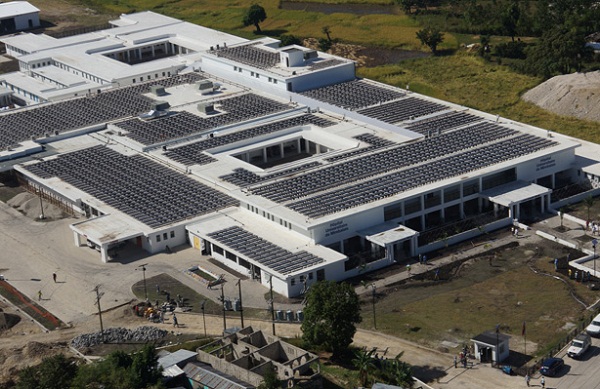
       Have you ever heard of a hospital running on solar power technology? Well, if you haven't, there apparently is one in Haiti. It's called "Hôpital Universitaire de Mirebalais," known as HUM, and because of the generous donations from Boston-based nonprofit Partners in Health, it was made possible.


As you can see here, the roof of the hospital is entirely covered with solar panels in this newly constructed hospital, featuring a total of 300 beds for hospitality.

   It actually serves as a great benefit for Haiti, due to their instability when the power grid is concerned. In Mirebalais, a rural town in Haiti, it is claimed that power goes out on an average of 3 hours per day. Because of this dilemma, many patients, undergoing surgeries, can constantly be jeopardized as well as other tasks performed in hospitals. Thus, they decided to go solar as many corporations in other nations have.
      The hospital is officially opening in March but before their official opening, the solar panels on the rooftops have received 139 megawatt hours of electricity, which is enough to charge 22 million smartphones and offset 72 tons of coal. With this excess amount of electricity, it will be fed back to Haiti's national power grid, giving a much-needed boost to their power sources. Amazing on how solar panels can just make a huge impact for a nation, huh?

Monday, February 4, 2013

Robots taking over the world!

Introducing "Qbotix," the world's first monorail robot, equipped with 20 solar panel arrays, trailing behind a small tuna-shaped robot called the "Solbot." Over time, the sun moves 10 degrees in approximately every 40 minutes, decreasing the efficiency of our solar panels that are being engineered today all across the world. So, in order to get the job done more efficiently in harvesting the energy of the sun from sunrise to daybreak, "Qbotix" had designed a robot that moves through steel pipes like a small roller coaster, tracking the position of the sun while moving with it in order to retrieve the most efficiency of the sun without consuming much energy during the process.
A California based startup, Qbotix, has now come up with a robot that does the job efficiently without consuming a lot of energy in the process.
However, here's Germany with their huge robotic arms engineered to install solar panels onto steel racks. This robot is called "Momo" and it could do the work of 250 workers required to build a 100 megawatt photo voltaic power plant. The main idea of this project was to save large amounts of money, mainly towards labor. Towards a construction of a 14 watt solar plant, reports say that the company could cut the cost nearly half of what they had originally paid in which it came up to approximately $2 million in total. 
Renewable robot: A robotic arm places a large photovoltaic panel onto a frame during the construction of a solar plant near Leipzig, Germany. The panel is nearly six square meters in size and weighs 120 kilograms.