Showing posts with label design. Show all posts

Wednesday, August 7, 2013

Eye catching solar clothing designed to charge phones

           Wearable Solar, a potential clothing line, designed to fit today's fashion with the use of solar panels that are embedded into garments providing steady power onto your smartphones on the go. The project was led by Christiaan Holland, fashion designer Pauline van Dongen, and solar panel specialist Gertjan Jongerdan, and with a little help from students from the University of Applied Sciences in Nijmegan, Netherlands. A dress and a coat were created as prototypes and Van Dongen stated that she carefully studied the structure of human skin and rendered it to her own design. For example, the shoulder flaps, embedded with solar panels, are designed to unfold in broad daylight and folded away easily and can be worn invisibly.
           "The coat contains fairly rigid solar cells, which is why I used a combination of wool and leather. These materials both provide the strength needed and are aesthetically pleasing," said Van Dongen. "In total some 48 solar cells are incorporated into modular leather panels, allowing a typical smartphone to be 50% charged if worn in the full sun for an hour."


Thursday, June 20, 2013

Charging Stations in NYC

          Low on your electronic device battery, whether it's your tablet, phone or mp3, and need that extra charging boost? Tired of constantly looking for a store in the city that may have a spare outlet to plug your charger and charge it? Well, thanks to AT&T, Goal Zero and Brooklyn-based design studio Pensa called Street Charge, there will be 25 new solar stations. In other words, it defines as a convenient and fresh way to charge your device within a few blocks from your location.
          Street Charge will be equipped with iPhone 4 and iPhone 5 chargers, as well as microUSB and USB cords for charging other devices. The solar power is derived from three 15-watt solar panels and is stored in lithium-ion batteries, both provided by Goal Zero, and thus, has the capacity to charge your device day and night. The devices are able to charge within a couple of hours, specifically in 4 hours.


For more details, click here.

Wednesday, June 19, 2013

Marine Solar Park built as a landmark in Changwon, Korea

The Marine Solar Park was first constructed by the Ministry of Knowledge and Economy as the world's tallest solar tower, which was built as the nation's landmark in 2006. The solar park is composed of two sections: the exhibition floor and the solar panel tower that is constructed above it. The solar tower stands firm in 136 meters high and the entire floor space is 6,336 square meters across a spacious lot of 14,977 square meters. With a shape of a sailing ship, the solar tower can generate 1,264 kW a day with a capacity of 600 kW/h, equivalent to the total energy consumption of 200 households. The four story exhibition floor will accommodate a 644 square meter conference room that can seat 500 people at a time. In the near future, the Marine Solar Park will not only be a tourist attraction but a learning site to steer many towards a cleaner environment with sustainable renewable energy and a business center for companies.

Marine Solar park constructed on top of Eumjido in Jinhae-gu
Outside view inside the exhibition floor

Friday, June 14, 2013

Featuring: The Husqvarna Automower Solar Hybrid

          For those living in the rural areas surrounded by grass, it would be a hassle to continuously trim those weeds and plants with a lawnmower that you may haul towards the ground back and forth. Therefore, it is no surprise that Husqvarna Global Design Centre, located in Sweden, has thought of the idea to create a robotic lawnmower that is able to complete the task for you, whether you are at home, away or even when it is raining outside.

       
          There is four main components to the lawnmower: its body, charging station, transformer cable and loop wire. 90% of its body is made of recyclable materials and it is quite small in size (almost equivalent in size to a carry-on luggage). In addition to its charging station, it comes with a large integrated solar panel. This, in turn, helps cut the lawn in a shorter period of time while having a lower power consumption and an extended battery life.

For more details, click here.

Thursday, May 30, 2013

3 Amazing Innovations in Solar technology

1. The SolarKindle
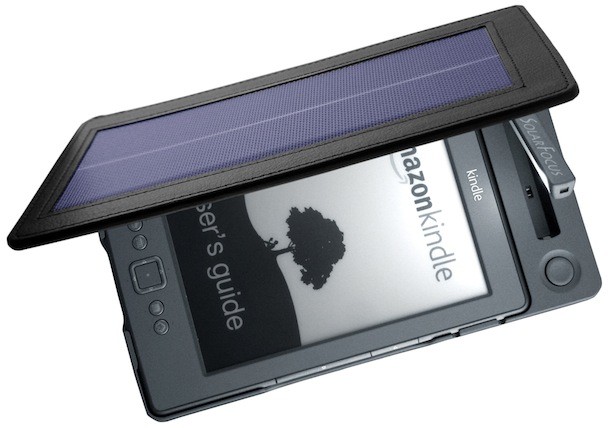
One product that grabbed much attention at this year's Consumer Electronics Show was a cover case with a solar panel for Amazon's Kindle E-reader, showcased by Solar Focus. From just one hour of stable sunlight, the SolarKindle collects enough power to your device for 3 consecutive days. What's more amazing is that the SolarKindle is advertised as being able to be powered 3 consecutive months under "normal" sunlight conditions.
2. Artificial Leaf
A researcher from MIT has developed a technology in what he calls an "Artificial Leaf", which is an energy storage technology that successfully mimics the process of photosynthesis. The so called "Artificial Leaf" is engineered to use solar energy to split water into hydrogen and oxygen, providing a fuel cell making off-grid lifestyle possible. It has been confirmed that Sun Catalystix will work on many products using only renewable energy, fueled with electricity for household items and tools. The product is soon to be advertised for commercial use.

3. The Lotus Position
What they call "Lotus", is a structure designed to charge up electric vehicles as well as lighting up the streets with LED lighting. An italian architect Giancarlo Zemo along with an architectural design company known as "Luminexece" has created a multi-function design. A small "Lotus" generates 500 watts of electricity and larger models generates 2.8 kilowatts. The structural design most definitely is envisioned as a solar powered charging station for electric vehicles for the future.


Tuesday, March 26, 2013

New Solar Gear Introduced

            Inverters are the components within powered devices like solar panels and batteries, which helps convert the power generated into usable power. There has been many research efforts involving solar panel inverters as some people may choose to move from a single large central inverter to smaller "microinverters" embedded on each solar panel. However, Empower Micro Systems, a chip startup that has been running for a year and a half now, has furthered this research and developed a low-voltage solar microinverter based on new chip designs, which has became more reliant, cost-effective, and efficient.

            Empower Micro Systems CCO Jon Bonanno has claimed that the company's inverter technology "is a quantum change in how solar is done." This newly developed chip component can be applied anywhere from a solar panel system to a rack or frame. Bonanno also notes that the inverter is 5x more reliable, 5% more efficient, and costs 20% less than traditionally used inverters. The overall solar system cost can be lowered because of the rising potential of a lower inverter cost, in addition to the dropping prices already of solar panels.
           Empower Micro Systems does not plan on manufacturing the inverter box itself but the company tries to respectfully adopt Intel's code in churning out the chips inside the inverter devices. Bonanno is confident of the power of the inverter technology, which is known as the "Universal Micro Power Inverter." He believes it can "replace all solar inversion options, hands down." The key technologies of the solar inverter includes how the system on a chip synchronizes and controls the power flow at a low-voltage rate as well as the design of the inverter box.
           Bonanno remarks that the company has already signed one agreement with a "top-three" module maker (and is in discussions with many module makers and product vendors) to bring this hardware into the market. This year, it is planned for the inverter to be certified and could be produced in pilot production by the third quarter of 2013.

Saturday, January 19, 2013

Bracelet mobile phone powered by the sun!

Two designers, Seungkyun Woo and Junyi Heo, inspired by the process of photosynthesis, incorporates a bracelet designed to make and receive calls and text messages powered by the sun. To explain it more in-depth,  the solar cells, located on the front panel, juices the device. The cradle dock also hosts cells on the back as a backup panel to power your bracelet. There will never be a time that you will go crazy about losing your phone once realizing your phone had been with you all this time. Best wishes to them!