Showing posts with label Sun. Show all posts

Monday, September 30, 2013

In Newark, NJ, "Solstice" Built on Campus

       In Newark, New Jersey, the "Solstice," a charging station powered by the sun, is ready to renew the energy of the cell phones, laptops and other electronic devices used at Essex County College thanks to the efforts of a group of ECC students.
       Members of the Leadership in Energy and Environmental Design and Solar Training class erected the station, mounted on a 9-foot pole outside the college's Center for Technology. It has one AC and two USB ports that allow charging of devices completely through solar energy. "We are primarily using it as a hands-on learning tool for both our students and area high school students," said professor Ravi Manimaran. He noted that the 14 students who participated in the installation had the chance to receive green industry-based training from professions as part of the hands-on project.


Thursday, July 25, 2013

Solar Panels Helps Cool Buildings (like Trees)!


         Usually, trees provide us shade for buildings, whereas we are kept cooler than in if it were to be fully exposed by the sun. However, these days, solar panels, when mounted onto the rooftops of buildings, are able to also provide us comfort and shade (along with generating clean electricity). 
          Researchers at the University of San Diego took a closer look at the solar panels' cooling effect to see how big the effect is and what kind of panel orientation can reap the most benefits." They note that "Using thermal imaging, researchers determined that during the day, a building's ceiling was 5 degrees Fahrenheit cooler under solar panels than under an exposed roof."


Friday, May 31, 2013

Kettle Chips Tests Renewable Energy in Salem

       Kettle Brand currently has enough solar panels on the roof of its Salem plant to make 250,000 bags of Kettle Chips, even though this is applicable when the sun is available. A new smart-grid project is being launched today, whereas they persevere in testing the renewable energy stored in a room full of lithium-ion batteries to help aid the solar power plant in Salem. These batteries to be used are stored in a newly established facility, known as Salem Smart Power Center, which can store up to 5 megawatts (in other words, has the capacity to power 3,500 homes).
      "This is the first of its kind in the nation and in the industry," said Kevin Whitener, smart-grid project manager for Portland General Electric. "We're used to calling upon energy sources when we need them, but sun and wind aren't great for that. With this project, we can take that sun and wind energy and store it so it can be available when our customers want to use it."

Kettle Foods potato chip factory in Salem has 616 solar panels on its roof, but the amount of power they produce fluctuates with the availability of the sun 

Wednesday, May 22, 2013

Solar Power Helps Pump Oil

      Built by GlassPoint Solar, a Fremont company that uses renewable power to squeeze oil from the ground, a new solar steam plant has been developed in the Middle East, specifically the Omani desert. GlassPoint Solar, raising approximately $32 million in venue capital, has a small pilot plant in Kern County that has been generating steam for two years. Known as the Oman plant, it is 27 times bigger than the relatively small pilot plant, producing a average of 50 tons of steam per day.
       "Oman doesn't have the massive oil reserves of some of its neighbors, and its production started declining more than 10 years ago," said John O'Donnell, GlassPoint's Vice President of Business Development. "Steam-flooding an old field can help boost production. Plus, Oman has heavy oil deposits that are hard to develop without steam." O'Donnell added, "most steam-flooding operations burn natural gas to generate the steam, but Oman doesn't have large gas reserves of its own. And the price of importing it is high, more than three times its current cost in the United States."
         GlassPoint's technology is a low-cost twist on the conventional display of solar power plants in the past. GlassPoint's mirrors are made from thin, lightweight and inexpensive aluminium sheets. A decent breeze could knock the mirrors out of alignment so GlassPoint has them inside of glass greenhouses. Most of the materials can be bought from shelves from many suppliers. "Solar will be, by far, the cheapest way of complying with the standard," O'Donnell said. "As that develops, obviously we'll be keenly interested. We're a California company."

GlassPoint Solar

Sunday, May 19, 2013

Solar Chaser Toy Uses Sun to Play (for Cats!)

      Even little things in life can spark a joy in a cat's life, especially those laser toys or even a piece of string, but consider this new toy powered by the sun to let the cat have some fun. Known as the Solar Chaser, this device is essentially a cat toy on a wand that happens to stick on the window with suction cups. When it absorbs enough light, the toy, with an accompaniment of a string attached, will be able to  move, encouraging the cat to chase it.
      If you may want some time to relax, this Solar Chaser only costs $40 (solarchasers.com). Hey, it may come in handy sometimes when you want to sit back and relax in peace while the cat enjoys its new toy.


Monday, May 13, 2013

Solar Flare of May 12 and May 13, 2013

      According to space weather experts, a hyperactive spot on surface of the sun has fired off two of the most powerful solar flares of the year in simply 24 hours, and is showing promising signs that it will unleash more solar storms over the course of the next several days. The active sunspot has actually went on overdrive on Mother's Day when it had erupted late Sunday night (May 12) with an X-class solar flare, which is the strongest type of solar storm possible, said NASA scientists in an update.

The sun had erupted with an X1.7-class solar flare on May 12, 2013. The flare had appeared as a bright point on the left of the sun in this full-disk view of NASA's Solar Dynamic Observatory. It is a blend of two images of the sun recorded at different wavelengths of light
      This giant solar flare, which is categorized and registered as one of the largest eruptions the sun can unleash, had peaked Sunday night at 10:17pm EDT (02:17 GMT) and was captured on camera by NASA's Solar Dynamics Observatory. It had sparked an hour-long high-frequency radio blackout, according to the Space Weather Prediction Center overseen by the National Oceanic and Atmospheric Administration. Shortly after, on May 13, another eruption had followed midday on Monday by an even more powerful X2.8 solar flare, which is the third-strongest solar storm in reent years. A video of the huge solar flares seen together can be shown here.
       The Mother's Day solar flare had sent a super-hot wave of solar plasma, known as a coronal mass ejection, hurtling through space at about 2.6 million mph (4.3 million km/h). The second flare on Monday is known to send solar plasma streaking through space at a rate of 4.3 million mph (6.9 million km/h). However, the solar eruptions were not aimed at Earth so should not be posed as a threat to satellites and astronauts in orbit, claimed by NASA officials.

On May 13, 2013, an X2.8-class flare had erupted from the sun, the strongest flare of 2013 to date. This NASA image shows a close-up of the flare as seen by the Solar Dynamics Observatory in the 131 angstrom wavelength

Tuesday, April 30, 2013

Solar Day Pilipinas -- A Yearly Event From Now On

      During this extreme heatwave coming this summer in the Philippines, there lies potential for solar power to grow as our reliance on fossil fuels can be reduced or dimmed. The Philippine Solar Power Alliance (PSPA) and the World Wide Fund for Nature Philippines (WWF) has, in fact, celebrated their very first Solar Day Pilipinas 2013 on April 26. PSPA President Dante Briones had described solar power as being a cutting-edge technology and a tool for improving national competitiveness, especially in the Philippines. "The country is actually one of the leading countries in Asia when it comes to solar energy," Briones said.
      Solar power is also estimated to produce 20-30% less emissions of harmful gases than coal power. "Why do we have to thoroughly dig the soil just to look for coal when all we need is to raise our heads to see the sun?" said Claire Marie Yvonne Lee, PSPA Vice President. According to Lee, she observed that many businesses and institutions have already begun to start using solar panels. Some of these, she points out, are Starbucks, the Asian Development Bank, the Makati Medical Center and the Department of Trade and Industry.
       Solar power, however, proves to be quite costly. As a matter of fact, the cost of acquiring one solar panel may exceed the initial savings generated from not connecting to the country's power grid. Though this may be so, PSPA and WWF believe that as costs decrease, solar panels will be economically efficient over time. In addition, solar technology usually is covered by a 25-year warranty. "A solar system is a good investment," said Lee. "Unlike a car or a cellphone, it's not a dead investment," she added.
       At Solar Day Pilipinas 2013, there were products of various solar power developers showcased for the public to view. The products consisted of a range of solar phone chargers to large-scale solar systems for residential areas and commercial establishments. Ten solar power developers present were included as follows: Renewables Made in Germany, MERALCO, Tritec, Transnational Uyeno Solar Corporation, GNB Exite, Maschinen and Technik Inc., Cagayan Electric Power, Sasonbisolar Inc., One Renewable Energy Enterprise Inc., Solutions Using Renewable Energy Inc., CEnAG, SunPower Inc., and Propmech. "Solar Day Pilipinas will be a yearly event from now on," said PSPA Founder and Chair Teresa Cruz-Capellan.

Wednesday, March 6, 2013

Lancaster, California Requires Solar Panels on Homes by 2014!

        In a recent announcement made by Mayor Rex Parris, there is a requirement that states solar power systems are to be implemented within every newly built single-family houses within the city by January 1, 2014. These recent stated requirements will be written into Lancaster's "Residential Zones Update." It specifically states as followed: "The purpose of the solar energy system standards is to encourage investment in solar energy on all parcels in the city, while providing guidelines for the installation of those systems that are consistent with the architectural and building standards of the City."
         With these requirements in place, residential homes on lots larger than 7,000 square feet will need to possess a system of 1.0-1.5 kilowatts. If there are residential homes in rural areas which holds lots up to 100,000 square feet, they are required to possess a system of at least 1.5 kilowatts. Homebuilders, though, have an alternative in forgoing these requirements by providing proof of purchase of solar energy credits from a solar energy development located within the city.

Mayor Rex Parris is shown, speaking at an event in Lancaster to celebrate the 100th solar-powered home.
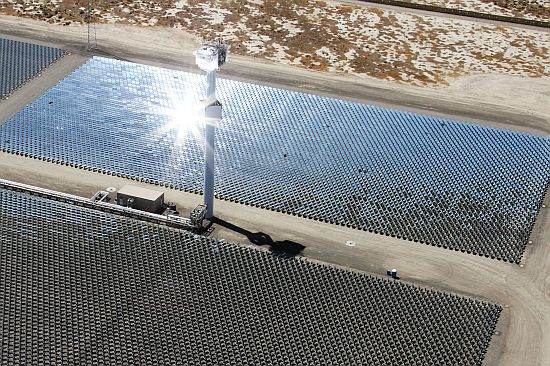
          Mayor Rex Parris may be a Republican but he is an extreme solar power advocate for he strongly supports his intentions to make Lancaster, California "the solar energy capital of the world." In the year 2010, Lancaster has had a partnership with SolarCity to launch a successful solar financing program for nonprofit organizations, businesses and residential areas. It is known as "Solar Lancaster" and this 1.45-megawatt program extends towards helping solar finance the city hall, the Lancaster Performing Arts Center, Clear Channel Stadium, churches, schools, and other areas. Solar Lancaster is expected to generate $1.5 million annually through 2017 and then $800,000 per year for the next 20 years. In addition, Lancaster is scaled with many solar production plants, including the infamous eSolar's Sierra Sun Tower.

eSolar's Sierra Sun Tower
       

Monday, February 18, 2013

Solar storm can throw us back 100 years

     Michio Kaku, whom is an American theorist physicist, author and host of his show on the Syfy Channel, is featured in an interview with Fox News. He claims that there is to be a predicted solar storm hitting earth in this year. He claims that every 11 years, North and South Pole flip to release a burst of radiation and every 100 years or so, a monster tsunami from the sun emerges, which can cause trillions of dollars in property damage.
     In 1859, there was a gigantic solar storm that knocked out telegraph wires in the United States and Europe, causing widespread fires. If this storm was to happen, it would knock out satellites, power stations, and cause food riots because refrigerators would not function because there would be no power source.

Let's take a look at what Professor Michio Kaku says about this storm.


Even NASA has given a warning of the coming solar storm in 2013. Encaptured footage of a giant sun eruption in 2012 but predicts a larger coming storm this year.


Friday, February 15, 2013

How to build a Solar Panel

1. Treat yourself to some powdered doughnuts and herbal tea. The powdered sugar on US-style doughnuts contains titanium dioxide (TiO2 or E171). This is a semiconductor that can be used to make solar cells. To extract the TiO2 in a useful form, first scrape off all the powder and put it in a cup of warm water. Stirring this will dissolve all the sugar (there is a lot of it).

2. Running the whitish water through a coffee filter will leave behind a white blob -- this is the precious TiO2, along with some unwanted fat.

3. Because the fat is useless for solar cells, you'll need to put the residue in a hot oven for a few hours to vaporise it. The TiO2 remains as nanoparticles, each around 100nm wide.

4. Throw these particles into high-proof ethanol (vodka will do: use 1ml per doughnut) and shake.

5. Now conductive glass is needed (tough to find, but indium-doped tin oxide is best). With an eye dropper or syringe, drop ten layers of the nanoparticle spirit on the glass, allowing it to dry with each layer. Then put it back in the oven.

6. This is now a solar cell, but it will work only with UV light (the bad kind). Here is where the tea comes in. Leave the nanoparticle solar cell sitting in a cup of hibiscus tea for a couple hours, and soon it will have absorbed the colour, shifting its useful range from UV (useless) to visible light.

7. To collect energy from this solar cell, you'll need a counter-electrode. Take another piece of conducting glass and use a dark pencil to cover the surface with graphite.

8. To get your electricity to your counter-electrode, a generous amount of iodine in high-proof alcohol works well as an electrolyte. Use one part alcohol to three parts Lugol's solution -- available from health stores and aquarium suppliers.

9. Cut a hole in some thin plastic or tape to use as a spacer, and place it on the nanoparticle cell. Drop some electrolyte on top, and quickly sandwich the two electrodes together with some bulldog clips.

10. You're done! A multimeter connected to both of the conducting electrodes should show about half a volt when in the sun.

This article was taken from the March issue of Wired UK magazine.

Saturday, January 19, 2013

Bracelet mobile phone powered by the sun!

Two designers, Seungkyun Woo and Junyi Heo, inspired by the process of photosynthesis, incorporates a bracelet designed to make and receive calls and text messages powered by the sun. To explain it more in-depth,  the solar cells, located on the front panel, juices the device. The cradle dock also hosts cells on the back as a backup panel to power your bracelet. There will never be a time that you will go crazy about losing your phone once realizing your phone had been with you all this time. Best wishes to them!


Monday, January 14, 2013

Solar Technology around the World

     It has been reported recently that China has been the most highest demand towards renewable energy investors. Costs of solar technology had been falling drastically over the years and is expected to ease China's power shortage by 2015. Solar supplies are expected to be leveled to the same price as electricity fees that is passed on right now. Soon, there will be the era of Solar Panels around every residential and  commercial rooftops in a large scale in a short period of time as well as the supply of coal and oil dropping slowly but surely in our economic crisis with Obama's viewpoint towards the production of oil and gas.


     South Korea had also been following the crowd towards solar energy and the government had been, without a doubt,  the greenest government in the world. Largest industries and companies such as Samsung, LG, and Hyundai are making massive investments towards wind, solar, tidal, and nuclear energy onto vehicles, power supplies and home appliances.

Nepal is also not far behind in introducing solar technology.
Did you know you can conduct energy through human hair?
     In a recent discovery in Nepal, Malin Karki, a Nepalese teen who attends school in Kathmandu, invented  a solar panel that conducts static energy through strands of human hair called melanin. These pigments of hair are connected to each pin designed in a square panel that can produce up to 18 watts of power that costed him as low as $38 as a whole. Inspired by a book written by Stephen Hawking, he may have started an amazing revolutionary idea around the world.
human hair, nepal, nepalese teen, innventor, teen innventor, solar panel, solar power,