Showing posts with label installation. Show all posts

Monday, August 12, 2013

Honda Sells Renewable Energy in Japan, 2015


          The new Honda facility, located in Sakura, Japan, is where the automaker is planning to install a "mega solar system" that can produce 10 megawatt a year on a new test course. After installing a total of 70,000 solar panels on 82 acres, the track will cover approximately 62 acres, which will be used for testing "advanced safety technologies." Honda currently does not have any plans for much electricity use in Sakura but hopes to also join the green community by building a biotype on the property so that members of the local community may come and enjoy it.
           Honda's 82-acre solar farm is planned to be larger than Hyundai's 50-acre solar field in Korea and Volkswagen's 33-acre solar farm in Chattanooga, Tennessee,  which are both shown below.

Hyundai's 50-acre solar field in Korea
Volkswagen's 33-acre solar field in Chattanooga, Tennessee

Wednesday, March 6, 2013

Lancaster, California Requires Solar Panels on Homes by 2014!

        In a recent announcement made by Mayor Rex Parris, there is a requirement that states solar power systems are to be implemented within every newly built single-family houses within the city by January 1, 2014. These recent stated requirements will be written into Lancaster's "Residential Zones Update." It specifically states as followed: "The purpose of the solar energy system standards is to encourage investment in solar energy on all parcels in the city, while providing guidelines for the installation of those systems that are consistent with the architectural and building standards of the City."
         With these requirements in place, residential homes on lots larger than 7,000 square feet will need to possess a system of 1.0-1.5 kilowatts. If there are residential homes in rural areas which holds lots up to 100,000 square feet, they are required to possess a system of at least 1.5 kilowatts. Homebuilders, though, have an alternative in forgoing these requirements by providing proof of purchase of solar energy credits from a solar energy development located within the city.

Mayor Rex Parris is shown, speaking at an event in Lancaster to celebrate the 100th solar-powered home.
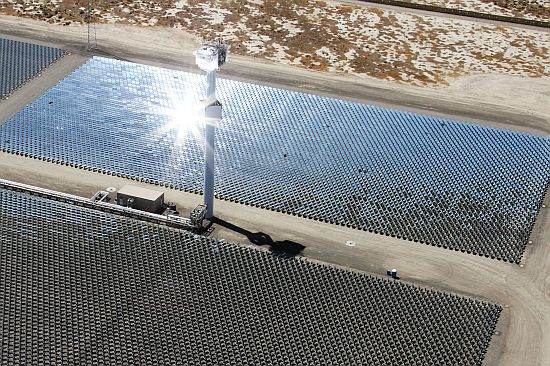
          Mayor Rex Parris may be a Republican but he is an extreme solar power advocate for he strongly supports his intentions to make Lancaster, California "the solar energy capital of the world." In the year 2010, Lancaster has had a partnership with SolarCity to launch a successful solar financing program for nonprofit organizations, businesses and residential areas. It is known as "Solar Lancaster" and this 1.45-megawatt program extends towards helping solar finance the city hall, the Lancaster Performing Arts Center, Clear Channel Stadium, churches, schools, and other areas. Solar Lancaster is expected to generate $1.5 million annually through 2017 and then $800,000 per year for the next 20 years. In addition, Lancaster is scaled with many solar production plants, including the infamous eSolar's Sierra Sun Tower.

eSolar's Sierra Sun Tower
       

Friday, March 1, 2013

A Closer Look into SolarCity

      SolarCity has gone public during a rough time in 2012, where they were forced to close 47% above its $8-a share initial public offering price because investors were being initially unreceptive. The original offering price SolarCity had in mind was estimating between $13 and $15, causing it to raise $141 million. However, since they were forced to lower their share prices, they raised $92 million.
      Besides Enphase Energy (ENPH) opening public in March, SolarCity is actually the first clean technology company to get involved publicly while the stock market, in reference to solar energy, has been failing (due to the Chinese leading because of its low prices). Enphase Energy, a company which makes products to help improve solar efficiency, has had its stock price lowered by half. BrightSource Energy, another solar company planning to go public in April, had cancelled its initial public offering price.
      Recently, SolarCity has been able to make a comeback and raise their stock price from $8 to $19. The reason for this was released in an interview by Fortune Magazine; SolarCity comments "our business is totally different. We're an energy company. We install solar systems for free, and we sell the electricity at a lower rate than you can buy it from the utility. So given the option of paying more for dirty power or paying less for clean power, what would you take?"
     SolarCity has previously commented that they install solar systems for free but this option is only available as long as you reside in the 14-state territory where their locations operate. They also took consideration in deciding what states to hold their operational locations in by looking at the current price of electricity, observing how much sun the market receives, and looking at the state's tax incentives. For example, in Arizona, there is cheap electricity but they obtain an incredible amount of sun. In Oregon, there isn't a great amount of sun but Oregon has a strong state incentive, whereas they want to see residents adopt clean energy.
     SolarCity also operates in marketing their products in Home Depot. While potential customers walk into Home Depot to purchase products, solar consultants explains that they can get a free solar system and pay less for electricity. They only pay Home Depot per customer they sign up.
     There seems to be some great potential in SolarCity because they indeed have a different business model. Who wouldn't love to indulge in a free solar system, where you're able to pay less for electricity? Now, if only they opened their locations in many areas in the East Coast.


Wednesday, February 27, 2013

Affordable Solar Power for Californians!

        In these times, Californians have the option of putting rooftop solar panels onto their residential buildings, but they may fall short because of the cost. That's where affordable solar power comes in with the help of two statewide California solar programs!
        Multifamily Affordable Solar Housing (MASH) is one of the programs that help provide non-costly solar power. This program evaluates and qualifies eligible buildings for solar incentives to help offset the project costs of installing solar on housing. The goals for this project would include: stimulating the adoption of solar power in affordable housing areas, bringing more awareness into the community about solar power, improving energy utilization, and decreasing the electricity costs for low-income households.
       Another program is known as Single-Family Affordable Solar Homes (SASH), which is funded by many public and private sources. It is also administered by a nonprofit organization, Grid Alternatives, which holds one-on-one meeting sessions to engage low-income families with the knowledge of sustainable energy as well as promotes workforce development through the rapidly growing presence that solar power is gaining. Grid Alternatives is also a licensed solar installer so they are able to lead teams of the solar power industry to aid them in installing solar panels.
      However, installing rooftop solar panels can be quite expensive because the "soft costs" of the installations are involved, which includes the costs of permitting, site design and grid connection. Thankfully because of the SASH program, Grid Alternatives helps families through the entire process of installing the rooftop solar panels, as said previously. The SASH program also includes the option to apply for weatherization and energy efficiency upgrades to help California low-income households obtain the best quality assurance with energy sustainability.

Grid Alternative features industry and community volunteers in installing solar electric systems in residential areas

Thursday, February 21, 2013

Knoxville Zoo in Tennessee has Solar Installations!

      The Knoxville Zoological Gardens, located in Tennessee, has been the first zoo to receive solar installations, which 196 solar panels have been placed across the roof of the Stokely African Elephant Preserve Habitat. This installation has been ordered by Knoxville-based energy contractor ARiES Energy (Alternative Renewable Innovative Economic Solutions for Energy). Specifically, this installation has been made due to a partnership the nonprofit zoo has with Wampler's Farm Sausage and Family Brands International, which they are financing $170,000-$180,000 to construct the solar panels.  In return of this construction, the zoo leased the roof of the barn at its African elephant natural habitat from the Lenoir City-based Wampler's Company. Not only that but they are also supposed to sell Wampler's and Family Brands products such as its barbecues, bacon, and hot dogs at their concession stands.
       The solar installation, alone, could produce 55,595 kilowatt hours of power a year, which actually saves the zoo $825,000 of utilities on water, sewer and gas charges, etc. It also helps the zoo by reducing its carbon footprint, providing environment conservation, and it puts the Knoxville Zoo in a leadership position over other zoos in Tennessee for its green solar installation.

This is Knoxville Zoological Gardens before the solar panels installation
This is Knoxville Zoological Gardens, in progress of the solar panels installation, still to be completed

Wednesday, February 20, 2013

UPS, the delivery giant, gets involved with solar!


      Within these past few year, many companies have been getting involved with solar-powered technology as it is impacting the world on a global level. They have mostly been focusing on producing and installing solar panels to obtain electricity in a healthy cost-efficient way. One major corporation, known as the UPS, realized its benefits in this expanding time and has made it official by announcing its latest project, in installing solar energy installations in its locations in Parsippany and Secaucus, New Jersey.
      The project that was constructed in Parsippany, New Jersey, was a 1.2 megawatt installation that was completed last Fall in the year of 2012. The project in Secaucus is said to also produce a 1.2 megawatt installation that will be completed at the end of Spring this year. In a public statement, Steve Leffin, whom is the director of global sustainability at UPS, claimed that he and his team will be overseeing every aspect of the design and installations, which he believes to be extremely beneficial.
      "Federal and state government incentives and state government incentives encouraged our investments in solar energy sources," said Steve Leffin. "We develop, engineer, own and operate our solar capacity, which is a departure from contracted power-purchase agreements in which a company pays a solar power provider for a set price of electricity for 20 years. Under this arrangement, we not only benefit at UPS, but can also help community power grids by providing a hedge against possible energy price hikes during peak usage times."

Source : UPS pressroom