Showing posts with label electricity. Show all posts

Thursday, November 14, 2013

Google Invests $80 Million to Open 6 Solar Energy Plants


        Google is investing $80 million in 6 new solar plants in California and Arizona that the company says will provide enough electricity for 17,000 homes in the United States. The investment is Google's 14th in renewable energy. The company has so far put more than $1 billion behind solar and wind projects since April 2010. Google is partnering with investment firm KKR for the venture; the lead developer is Recurrent Energy.
       According to a Google blog post, the projects have a combined capacity of 106 megawatts. A typical coal power station produces 600-700 megawatts while a nuclear power plant puts out 900-1,300 megawatts. Google currently gets 33% of its energy from renewable sources, but hopes to be 100% reneawble at some point.

Thursday, September 26, 2013

Japan Growing in Renewable Energy Sources

A man watches waves break into anti-tsunami barriers after a storm in Iwaki, Fukushima Prefecture on September 16, 2013. Tokyo Electric Power Co. (TEPCO), operator of the tsunami-crippled Fukushima Daiichi nuclear power plant, said on Monday it released what was believed to be untainted rainwater around the storage tank areas into the ocean in order to avoid flooding near the tanks due to heavy rains by Typhoon Man-yi

        According to new research released by NPD Solarbuzz, Japan has become one of only five countries to have achieved 10 gigawatts of cumulative solar capacity. While aiming to diversify its energy mix, Japan is developing its renewable energy sector, especially as it steers away from nuclear power following the disaster at the Fukushima nuclear power plant in 2011. The development of solar power in Japan slowed in the mid-2000s, partly due to a 10-year energy plan that favored nuclear power.
       With a shifting of focus toward renewable energy, and after a new law approving feed-in tariffs for renewable energy was passed last year, the Japanese government is giving incentives for the use of solar energy. The policy requires utility companies in Japan to buy electricity from renewable sources like solar and wind at a premium price for the next 20 years.

Thursday, May 23, 2013

Harvesting Electricity Directly from plants?

Researchers from the Universities of Georgia turned their heads towards the inspiration of nature. They are now developing a new technology in ways to generate electricity from plants. Plants are the most assured source for clean energy. Most of them operate at nearly 100 percent efficiency, providing the plant equal amount of electrons from every photons captured from the sun. If converting even a portion of this to electricity would greatly over power every solar panels being made with only 12-17 percent efficiency.

During the process of photosynthesis, plants convert the sunlight captured into water atoms that are split to hydrogen and oxygen which then produces electrons. The plants use these electrons to create natural sugars for in most part uses them much like food to advance towards reproduction and growth.

"We have developed a way to interrupt photosynthesis so that we can capture the electrons before the plant uses them to make these sugars," said Ramasamy, who is also a member of UGA's Nanoscale Science and Engineering Center.

In the near future, this technology can well be used in remote sensors or even portable electronics that require fewer power consumption.

"We have discovered something very promising here, and it is certainly worth exploring further," he said. "The electrical output we see now is modest, but only about 30 years ago, hydrogen fuel cells were in their infancy, and now they can power cars, buses and even buildings."


Ramaraja Ramasamy, right, and Yogeswaran Umasankar work together to capture energy created during photosynthesis. Ramasamy is an assistant professor in the UGA College of Engineering and Umasankar is postdoctoral research associate working in his lab. (Credit: Image courtesy of University of Georgia)


Tuesday, April 23, 2013

Sachin Tendulkar Helps Light India's Villages

      Sachin Tendulkar, an Indian cricket (the most popular sport in India) player widely acknowledged as one of the greatest batsmen in One Day International, has helped bring light into lives of over thousand residents of Velunje, in Nashik.

Boys in South India playing "Cricket"
Last year, the villagers were specially selected for a pilot project, where they are provided with electricity through free solar home lighting kits, in courtesy to a non-profit organization "Spreading Happiness." Encouraged by the pilot project's results, currently Schneider Electric, a French-based energy company, has another location in India and is offering similar benefits to over 25,000 villages across the country to celebrate Tendulkar's 40th birthday this Wednesday.
     This initiative actually has been started when Tendulkar was introduced to Schneider Electric's "In-Diya Lighting System," an innovative, affordable and flexible solution to bring reliable, efficient and green lighting to people living without proper electricity access. "In-Diya is a specially designed LED-based lighting system that operates on main power supply and/or solar power. It provides a backup of 8-15 hours for indoor use with 50,000 hours of lighting across its life-cycle," said an official.
      Aware of such challenges faced by many Indian villages, Tendulkar expressed a desire to Schneider Electric to help use "In-Diya" to light up the lives of Indian villagers, whom have been living in the darkness for years. "Sachin Tendulkar and Schneider Electric India have come together for 'Spreading Happiness,' a non-profit organization, to provide access to rural electrification by installing solar home lighting systems for the benefit of over 25,000 villagers in India," Schneider Electric said in a release. "This initiative has already begun a pilot project in Nashik and is currently impacting over 1,000 villagers," it added. Commenting on the initiative, Tendulkar said: "As a country, we cannot have our citizens still struggle with darkness in their lives with the setting of the sun. We have to use advancements in technology and the capabilities of international majors like Schneider Electric to deploy solutions which can brighten the lives of our countrymen."

Sachin Tendulkar

Saturday, April 20, 2013

Las Vegas Flips Power on 15,000 Solar Panels

Tom Perrigo, chief sustainability officer of the city of Las Vegas, "flips the switch" on their new three-megawatt solar panel installation on April 18, 2013
   
     With the action of Tom Perrigo "flipping the switch" on their newfound solar panel installation, city officials are celebrating for the installation would help provide energy to a nearby wastewater treatment plant. The ground-mounted panels have been tightly packed on 25-acres of city-owned land near Vegas Valley Drive and Nellis Boulevard. This site had previously been a vacant strip of land the city had used as a buffer for its wastewater treatment plant, which processes all of the city's wastewater on its way to Lake Mead.
      During the dedication ceremony, Mayor Carolyn Goodman had announced that the project was known to being part of the city's comprehensive sustainability plan, which includes renewable energy, energy efficiency, recycling and waste management. "It's all about sustainability for the city and our citizens to make sure that we're using every resource that we can to keep down the costs of energy," she said. "The council wants the financial resources we have available to go as far as they can."
      The $20 million project will generate 6 million kilowatt hours of electricity annually, enough to provide approximately 20% of the treatment plant's power. "Because the plant accounts for a third of the city's annual energy bill, the solar panels will provide a big savings," Tom Perrigo, the chief sustainability officer, said. "Our energy spend breaks down to about a third for wastewater treatment, a third for street lights and a third for city buildings," he said. "By providing solar here at this facility, we're able to make a big impact on the city's overall energy consumption."

Friday, April 19, 2013

Largest Solar Plant in Africa


    Recently, it has been announced that the largest solar plant in Africa has been ceremoniously brought online in Mauritania. The 15-megawatt plant will be expected to meet a full one-tenth of the nation's electricity demand and keep lights on in some 10,000 homes. Mauritania is currently crippled by its severe energy shortages and thus, its frail power grid is upheld by an unstable network of diesel generators. Therefore, with the help of the Sheikh Zayed Solar Power Plant, this brings good news to Mauritanians everywhere: the country's power demand is quickly growing and with the help of this fresh blast of solar power, it gives power to those in need during peak hours.
     If the name of the solar power plant is a bit unusual, it would possibly be because the construction was done by Masdar, Abu Dhabi's national clean energy company. If the name Masdar brings any recollection, it may because there is such a city as Masdar City, a futuristic town on the outskirts of Abu Dhabi which eventually is to be the world's first 100% carbon neutral city. However, Masdar is currently in the clean energy business worldwide and such as the solar power plant's creator, the Mauritania project is also.

   
    The solar power plant consists of some 30,000 thin-film micrograph panels which are stacked into the ground instead of cemented into a concrete foundation in an installation process that helps decrease the costs and necessary materials needed. "Energy access is a pathway to economic and social opportunity," Mauritania President Mohamed Ould Abdel Aziz said. "Electrification, through sustainable sources of energy, is critical in ensuring our people have access to basic services and is a step toward improving our infrastructure and long-term economic development."

Tuesday, April 9, 2013

Nanotechnology used to make Solar Energy 25% more efficient

        Sol Voltaics has announced recently that by using nanotechnology, it is helping build solar cell modules to be 25% more efficient than the solar cells marketed in society today. If the company is able to deliver SolInk as how it is perceived in advertisements, then this could mean it would help make it excessively cheaper to introduce solar cells to a more broader set of customers.
        This nanotechnology is said to have the capacity to make solar power in residential areas and business environments more affordable, which can be necessary to increase adoption of solar energy and to help compete at the same cost of electricity produced from fossil fuel plants. This argument alone has helped Sol Voltaics raise $11 million in funding from public and private Scandinavian investors.
         CEO of Sol Voltaics, Dave Epstein, has claims that with nanotechnology, "we can increase the efficiency of energy capture, conversion and storage. There's no smoke and mirrors here." With two advances, it is made possible. The team, led by founder Lars Samuelson (a Lund University professor), created a technology known as Aerotaxy, which makes it cheaper to create nanomaterials. With this, they are able to create gallium arsenide nanowires that can serve as solar collectors and that they can integrate directly into solar wafers, known commonly as solar cells.
          As a material, gallium arsenide has been used in solar for years because of its high reliability and high efficiency at converting light into electricity. However, gallium arsenide is expensive to manufacture. SolInk dramatically reduces the cost by minimizing the amount of materials being used. In addition to SolInk's benefits, rivals such as Innovalight (bought by DuPont) can boost a solar panel's efficiency from 15% to almost 16.1% while SolInk is claimed to build the efficiency from 15% to almost 19% or from 20% to 25%. The theoretical limit in converting sunlight to electricity is approximately 27% to 29%.
         With Aerotaxy, it helps build nanomaterials by mixing vapors in the air in just a second. The active materials, then, bond to form larger, uniform structures while in motion. Nanowires are literally able to grow in the air. Also, with Aerotaxy, it helps generate tens of billions of nanowires per second on a continuous basis. "It's like cranking out nanowires with a popcorn popper instead of a craftsman. That's the makings of an affordable and scalable technology for mass production," said Epstein.
          According to Greentech Media, demand for solar is growing globally as we know it, with the total number of gigawatts expected at 29.8 in 2012 to 50.8 gigawatts in 2016. Epstein figures that solar is here to stay, since the sun is the only resource that will surely outlast fossil fuels, wind, and other clean energy sources in the run. "In spite of what you might hear, solar is a healthy market," said Epstein.

CEO of Sol Voltaics, Dave Epstein

Sunday, April 7, 2013

150 MW California Solar Power Plant is Bought!

      The 150-megawatt Solar Generation 2 photovoltaic power plant, located in Imperial County (California), was recently bought by First Solar, Inc. The construction of this solar power plant is planned to start this year and is set to be completed next year. Once completed, the new photovoltaic solar power plant is to produce enough electricity to power more than 60,0000 homes while displacing more than 115,000 metric tons of carbon dioxide per year. This solar power plant will estimably save around 93,000 metric tons of water per year.
      The San Diego Gas and Electric Company (SDG&E) has agreed to purchase the electrical output under a 25-year power purchase agreement. Once this agreement is started, the photovoltaic solar plant is expected to provide over 800 construction jobs within Imperial County, which has been overcome with high unemployment.
       "We are very pleased to help SDG&E meet its clean energy goals and provide clean, reliable, renewable power to their customers," said Dana Diller, First Solar Vice President of U.S. Business Development. "We are also proud to once again bring the economic benefits of utility-scale solar development to Imperial County, where both county officials and the Imperial Irrigation District, with which this plant will interconnect, have been extremely supportive."
        The financial details of the new purchase is still unknown but it does include 40 megawatts of solar modules that the project had previously purchased from another supplier. First Solar, Inc., is actually planning to integrate those modules into construction and make up the difference with their own modules in order to complete the construction of the power plant. In addition, First Solar will be providing project development, engineering, procurement and construction (EPC), and grid integration services.


Saturday, March 30, 2013

New Apartments offer Free Solar Power

     Solterra, a newly found 114-unit apartment project is nearing its completion, is to be equipped with facilities such as a salt-water pool, games-filled clubhouse as well as a stand-up tanning salon. At this era in the declining economy, there is stiff competition for landlords to attract tenants, especially in luxury areas. Therefore, this sweet luxury area to call home opens in May and offers free electricity to residents.
     In San Diego, this may be the county's first "net-zero" energy project, whereas there is enough solar power cells being installed to provide all energy to be obtained by average users as well as common areas at the 4-acre site east of Interstate 15 at Mira Mesa Boulevard. If residents do not exceed the average use projected, they are guaranteed a rebate check in the mail.
     Company President Mike Neal claims that they offer this special incentive to residents because "we want them to choose us," he says. He believes it's the energy-saving features that he hopes will make a difference. "With our apartment communities we've previously put photovoltaics on, we noticed our customers had a real interest in it," Neal said. "Some of them would say 'How could that benefit my unit?' We took it upon ourselves to take this project and try to answer that question by providing it and see how the customer likes it."
     "The target tenant group at Solterra draws from all over the county and from all demographic groups," he said, "and the rental rate of $1,495 to $2,225 is comparable to housing costs in Scripps Ranch."


Friday, March 15, 2013

Solar is #2 in Sourcing Electricity (with graphs to prove it!)

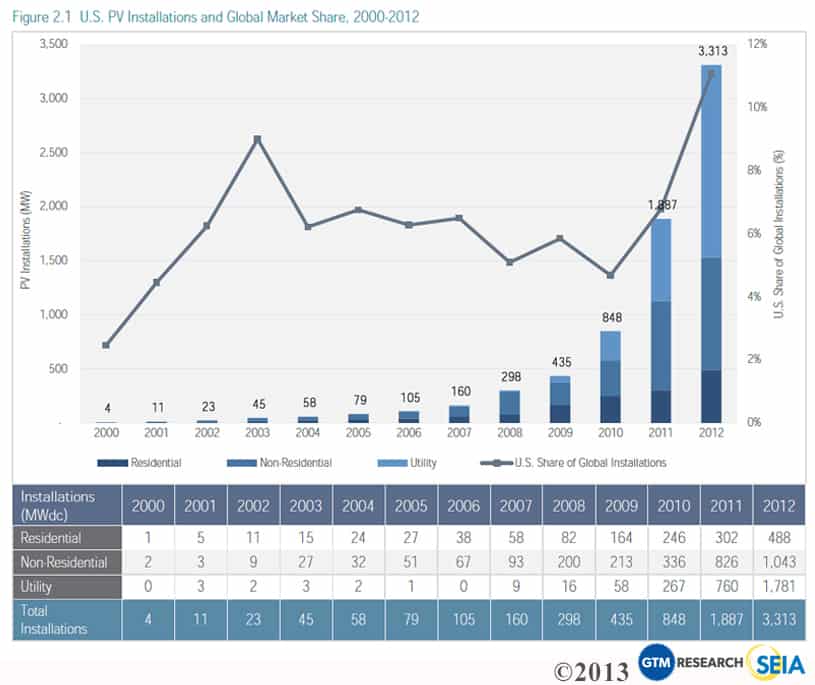
         Recurrent Energy CEO and Solar Energy Industries Association (SEIA) Chairman Arno Harris observed and seen that solar power capacity has been increasing in 2013 than any other electric power source, other than one of natural gas. By 2016, it perhaps may also be claimed that solar power, from this increasing rate of growth in society today, will be the #1 source for electricity.
        This solar power energy source has exponentially grew to be an outstanding presence in society today for a few years back, solar power was very costly as well as not being existent in many areas across the United States. However, as it is noted in a SEIA press release, data is extracted below to provide the analyzing trends in the U.S. solar market today.

From the statistics shown above, photovoltaic installations have grew 76% over time in 2011 to total 3,313 megawatts in 2012 (estimating market value of $11.5 billion)
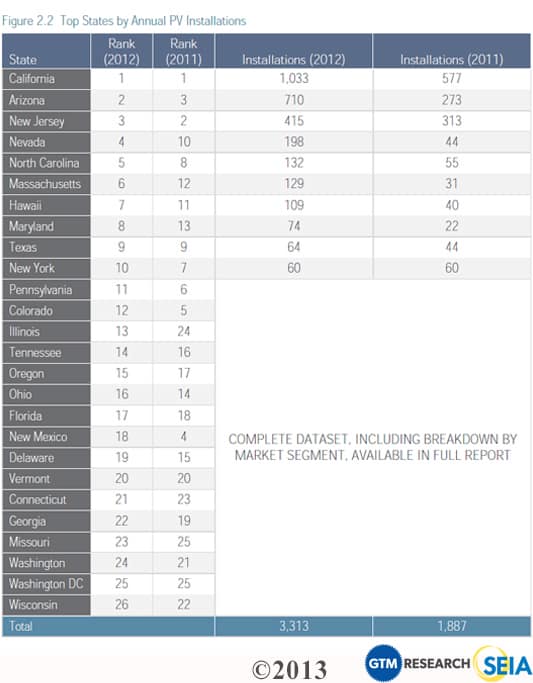
Above is shown a graph with U.S. states increasing the numbers of photovoltaic installations from 2011 to 2012

Tuesday, March 12, 2013

Mexico is Increasing its Solar Power!

       Driven by wealthy households and first large-scale power plants, Mexico has the potential to increase its photovoltaic capacity nearly tripling this year. Alvaro Lenz-Herrera, president of Asosiacion Nacional de Energia Solar, has commented in an interview that solar installations may double estimating from 30 megawatts to 60 megawatts, in which 30 megawatts are currently operating and may triple if its state-owned utility power grid, Comision Federal de Electridad (CFE), calls for a tender for increasing photovoltaic capacity.

Mexico initially desires to increase the awareness of solar power energy towards their generation and to reach their goal of having 35% of their power generating from clean, renewable energy sources by the year 2026. The country offers tax incentives in terms of solar power energy projects as well as providing possible long-term relationships with their power grid (CFE).

Photovoltaic capacity is expected to increase by the result of the falling solar panel prices and low system costs, which are claimed to be estimating 20% cheaper than solar power energy projects funded in the United States. Alvaro Lenz-Herrara also remarks that he predicts growth towards solar energy will increase in 2014 and 2015.

Monday, March 11, 2013

Walmart in Ohio is now powered by solar!

Walmart has announced that it has worked with SolarCity on progressing towards 12 Walmart stores & Sam's Clubs all over Ohio with installing solar panels that generates up to 6,000,000 kWh of energy, enough to power more than 820 homes and is also apprehended to accumulate about 5-20% of each store's energy consumption. Walmart has committed to increasing the use of renewable energy on all the stores in Ohio and across the country. Pretty effective knowing almost all Walmart stores are open 24 hours and finally being able to say bye bye to those outrageous electric bills.

"Walmart's installation of solar on 12 store rooftops is the largest solar commitment ever made by a retail business in Ohio," said Bill Spratley


Friday, March 1, 2013

A Closer Look into SolarCity

      SolarCity has gone public during a rough time in 2012, where they were forced to close 47% above its $8-a share initial public offering price because investors were being initially unreceptive. The original offering price SolarCity had in mind was estimating between $13 and $15, causing it to raise $141 million. However, since they were forced to lower their share prices, they raised $92 million.
      Besides Enphase Energy (ENPH) opening public in March, SolarCity is actually the first clean technology company to get involved publicly while the stock market, in reference to solar energy, has been failing (due to the Chinese leading because of its low prices). Enphase Energy, a company which makes products to help improve solar efficiency, has had its stock price lowered by half. BrightSource Energy, another solar company planning to go public in April, had cancelled its initial public offering price.
      Recently, SolarCity has been able to make a comeback and raise their stock price from $8 to $19. The reason for this was released in an interview by Fortune Magazine; SolarCity comments "our business is totally different. We're an energy company. We install solar systems for free, and we sell the electricity at a lower rate than you can buy it from the utility. So given the option of paying more for dirty power or paying less for clean power, what would you take?"
     SolarCity has previously commented that they install solar systems for free but this option is only available as long as you reside in the 14-state territory where their locations operate. They also took consideration in deciding what states to hold their operational locations in by looking at the current price of electricity, observing how much sun the market receives, and looking at the state's tax incentives. For example, in Arizona, there is cheap electricity but they obtain an incredible amount of sun. In Oregon, there isn't a great amount of sun but Oregon has a strong state incentive, whereas they want to see residents adopt clean energy.
     SolarCity also operates in marketing their products in Home Depot. While potential customers walk into Home Depot to purchase products, solar consultants explains that they can get a free solar system and pay less for electricity. They only pay Home Depot per customer they sign up.
     There seems to be some great potential in SolarCity because they indeed have a different business model. Who wouldn't love to indulge in a free solar system, where you're able to pay less for electricity? Now, if only they opened their locations in many areas in the East Coast.


Wednesday, February 27, 2013

Affordable Solar Power for Californians!

        In these times, Californians have the option of putting rooftop solar panels onto their residential buildings, but they may fall short because of the cost. That's where affordable solar power comes in with the help of two statewide California solar programs!
        Multifamily Affordable Solar Housing (MASH) is one of the programs that help provide non-costly solar power. This program evaluates and qualifies eligible buildings for solar incentives to help offset the project costs of installing solar on housing. The goals for this project would include: stimulating the adoption of solar power in affordable housing areas, bringing more awareness into the community about solar power, improving energy utilization, and decreasing the electricity costs for low-income households.
       Another program is known as Single-Family Affordable Solar Homes (SASH), which is funded by many public and private sources. It is also administered by a nonprofit organization, Grid Alternatives, which holds one-on-one meeting sessions to engage low-income families with the knowledge of sustainable energy as well as promotes workforce development through the rapidly growing presence that solar power is gaining. Grid Alternatives is also a licensed solar installer so they are able to lead teams of the solar power industry to aid them in installing solar panels.
      However, installing rooftop solar panels can be quite expensive because the "soft costs" of the installations are involved, which includes the costs of permitting, site design and grid connection. Thankfully because of the SASH program, Grid Alternatives helps families through the entire process of installing the rooftop solar panels, as said previously. The SASH program also includes the option to apply for weatherization and energy efficiency upgrades to help California low-income households obtain the best quality assurance with energy sustainability.

Grid Alternative features industry and community volunteers in installing solar electric systems in residential areas

Tuesday, February 26, 2013

Uruguay Plans Cheap Solar Energy!

       The South American nation, Uruguay, is offering contracts to buy power equivalent to 200 megawatts of solar farms at the world's cheapest rates. Ramon Mendez, a director of energy at the Ministry of Industry, Energy and Mining, has remarked that President Jose Mujica is planning to sign a decree that will require Uruguay's national power utility to purchase electricity from projects at a set rate of $90 a megawatt hour. The nation plans to produce some of the world's cheapest energy, referring mostly to solar and wind energy projects.
         China is offering Uruguay $160 a megawatt hour while Germany offers $154.33 a megawatt hour. Four months after the decree is passed, developers have the opportunity of proposing offers at a first-come first-serve basis. Mendez recalls that three companies have already proclaimed in selling at the price of $90 a megawatt hour. However, if the offers fail, they will plan to wait another couple of years until the equipment prices drop and they will try again.
        The decree that is to be issued also calls for a bid of developing a 1-megawatt and a 5-megawatt plant. Both these projects are to provide the national power utility power for 25 years at a price. Though this decree is currently in circulation, 80% of the nation's electricity is derived from hydroelectric power plants, costing on average $80 a megawatt hour. In a 2011 auction, Uruguay was offered a contract of  power at $63 a megawatt hour from wind developers. This nation has many projects in development to sustain their population as a low-cost nation.


Saturday, February 23, 2013

Free Solar Panels for Honda customers?

       Tesla Motors has been getting ahead in the electric vehicle market because of their newly produced car, Model S. Many car manufacturers are concerned with the shift in the market; this actually includes Honda Motor Company Ltd, the Japanese car manufacturing company to be established in 1948. Honda has recently decided to have a partnership with Solarcity, an American provider of energy services, to offer cheap solar power to eligible customers. They promised that with this incentive, they will be guaranteeing a utility bill for solar power producing a lower rate than grid-supplied energy. This not only includes cheap solar energy but, it also means the eligible Honda and Acura customers would be obtaining a rooftop solar panel installation, covering all the costs including the cost of the panels itself.
       The agreement that has been established between Honda and Solarcity is a power purchase agreement, which is a popular tactic to finance solar installations. Power purchase agreements are designed as contracts between two parties, whereas typically the property owner pays for electricity at a reasonable price rate for a period of time but the installer has continual access to own, operate, and maintain the system for that time period. It's not unusual for this partnership to also offer insurance, maintenance, repair and monitoring during the specified time period.
       Honda customers are able to pay for their bills up front in two ways: either pre-pay for the solar electricity or pay at a monthly rate which is lower rate than their utility bill. Surprisingly, Honda and Solarcity had invested $65 million into a fund for this agreement, which covers dealerships and customers located within Solarcity's few state service areas. This includes other efficiency upgrades for customers such as weatherization, a practice of protecting establishments and its interior from all weather (sunlight, precipitation, wind) and modifying it to reduce energy consumption and optimize energy efficiency.
     Not a bad deal if they're planning to be ahead of the other car manufacturers to be on a head-on competition with Tesla Motors, right? What do you think?


Wednesday, February 20, 2013

UPS, the delivery giant, gets involved with solar!


      Within these past few year, many companies have been getting involved with solar-powered technology as it is impacting the world on a global level. They have mostly been focusing on producing and installing solar panels to obtain electricity in a healthy cost-efficient way. One major corporation, known as the UPS, realized its benefits in this expanding time and has made it official by announcing its latest project, in installing solar energy installations in its locations in Parsippany and Secaucus, New Jersey.
      The project that was constructed in Parsippany, New Jersey, was a 1.2 megawatt installation that was completed last Fall in the year of 2012. The project in Secaucus is said to also produce a 1.2 megawatt installation that will be completed at the end of Spring this year. In a public statement, Steve Leffin, whom is the director of global sustainability at UPS, claimed that he and his team will be overseeing every aspect of the design and installations, which he believes to be extremely beneficial.
      "Federal and state government incentives and state government incentives encouraged our investments in solar energy sources," said Steve Leffin. "We develop, engineer, own and operate our solar capacity, which is a departure from contracted power-purchase agreements in which a company pays a solar power provider for a set price of electricity for 20 years. Under this arrangement, we not only benefit at UPS, but can also help community power grids by providing a hedge against possible energy price hikes during peak usage times."

Source : UPS pressroom

Did you know a bug can actually produce electricity?


This here is what is known for as the oriental hornet. Like many other insects or hornets, it is able to digest other insects. It lives in many areas of the western Mediterranean and India region, specifically in Algeria, Libya, Egypt, Sudan, Somalia, Saudi Arabia, Iraq, Iran, Pakistan, Afganistan, and the list goes on. 

So, how does this oriental hornet actually produce electricity?
    Well, the hornet's exoskeleton and the silk surrounding the pupae and its comb walls conduct electricity. The yellow stripe on its abdomen is capable of harvesting the sun's light and converting it into electricity. Its brown exoskeleton traps the sunlight, instead of it being reflected off the hornet's body.

But, how exactly does it work so that they can produce electricity?
      Within the oriental hornet's body, there are pigments that actually captures the energy of the sun's rays. Dr. Plotkin, whom was the researcher who discovered that the oriental hornet's abilities, commented that "the pigment melanin gives the hornet its dominant brown color; the pigment xanthopterin, in the head and abdomen in a form of stripes and bands, gives the Oriental hornet its bright yellow color." He also claims that "xanthopterin works as a light harvesting molecule transforming light into natural energy." This also explains why they become more active during the middle of the day, when the sunlight may be most intense. 

Saturday, February 16, 2013

New Solar Technology made from Carbon

Scientists at Sanford University developed a solar panel made entirely from Carbon making it more economical for everyday use. The panel is formed of a thin film that can be applied from a solution which means it could be coated onto buildings, cars, or even glass to generate electricity. The one downside of having the film all carbon is the fact that the efficiency is not so great, but the durability resulting much greater compared to our modern solar panels being manufactured today. Wonder how our economy may benefit greatly from this technological approach in renewable energy, this may be the beginning of a new revolutionary invention bringing many new ideas and innovations to our world, at the same time establishing a sanitary and sustaining environment.

Tuesday, February 12, 2013

Helping Slums in Africa have Better Lifestyles!

     In America, where freedom and an opportunity to live a better life is guaranteed, many American lives may take for granted what we are accustomed to having: electricity. In Sub-Saharan African urban areas, 589 million people are living without access to a public electric facility as well as dwelling in slums. That's where the iShack comes in!


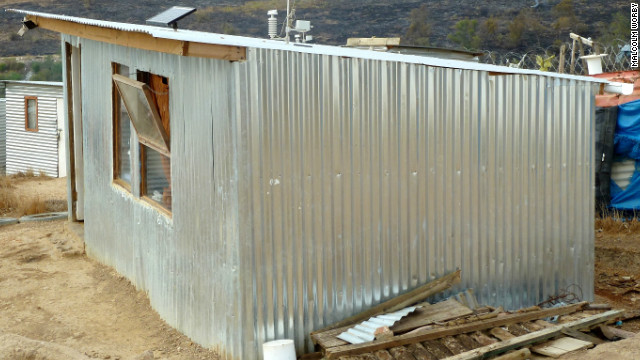
This is the iShack, which was developed by the University of Stellenbosch, where they were able to fund this experimental project using a grant from the Bill and Melinda Gates Foundation. It was developed to shelter families from the extreme temperatures in Africa as well as provide them with reliable power to sustain their lifestyles.

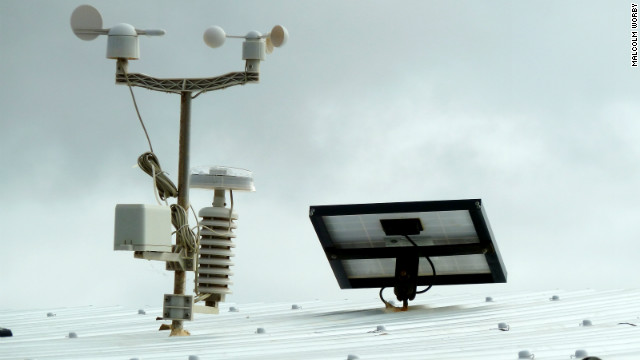
       This particular iShack is currently occupied by Plaatje, a domestic worker employed only once a week, and her three children. It is completely equipped with a photovoltaic panel, providing them with enough electricity to power three lights, a mobile phone charger and an outdoor motion spotlight. 


The structure of the iShack was carefully designed in that windows were placed strategically to provide them with better air circulation and sunlight heating as the roof was sloped to harvest rainwater during winter months. 

Upon living in the iShack, Plaatje and her three children claims that her lifestyle has improved drastically from where she used to dwell in, which was a cold, damp shack with a leaky roof and no electricity. Not bad of a transition for a family struggling as well as many others in Africa.